Lucy Parsons
A Revolutionary Portrait

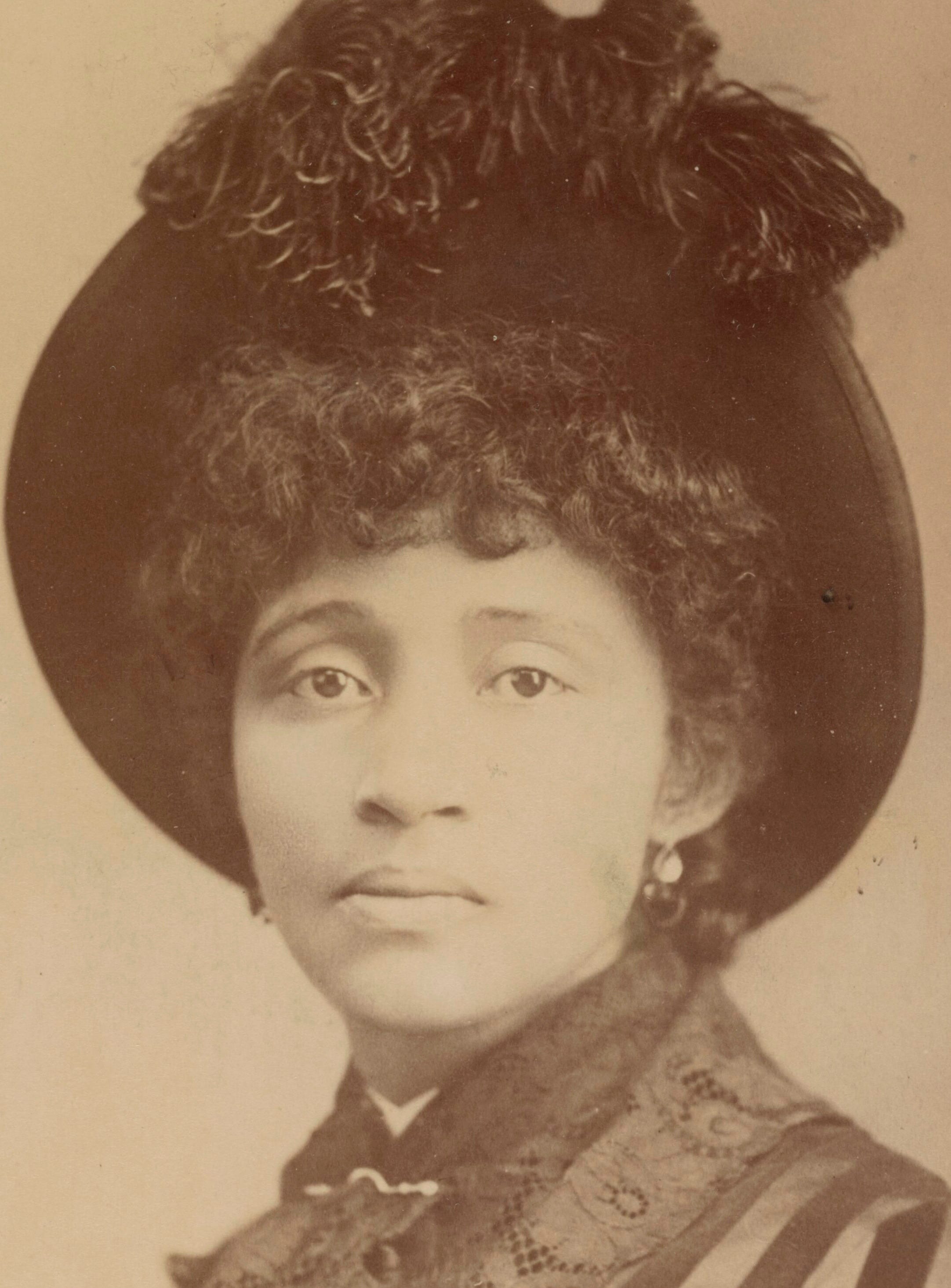
Lucy Parsons was a Black revolutionary who spent her entire life confronting power. For decades she tirelessly organized workers, spoke in the streets, wrote for radical newspapers, and helped build movements among the poorest layers of society. Police followed her, newspapers attacked her, and the capitalist state executed her husband. Still she continued her organizing. By the time she died in 1942 she had become one of the most formidable figures in the history of the American labor movement.
Lucy Parsons was born Lucy Ella Gonzales around 1853, most often associated with Johnson County, Texas, though some accounts suggest she may have been born into slavery in Virginia before moving west as a child. The details of her early life are difficult to pin down because Lucy sometimes altered her story publicly, which makes sense in a country defined by racial violence and constant surveillance. What is fully clear is that she came of age during the final years of slavery and the violent collapse of Reconstruction, in a society where racism and economic exploitation structured every part of daily life, and where survival demanded both cunning and courage. In this white supremacist crucible, Lucy Parsons embodied the tangled history of the United States itself. Being of mixed African American, Mexican, and Native American descent, she grew up navigating overlapping systems of oppression, experiences that forged the political clarity and revolutionary resolve she carried into the struggle for labor, gender, and racial justice.
During her early years in Texas, Lucy Parsons was immersed in the lives of people who had survived slavery and were struggling to carve out new existence under the violent backlash of Reconstruction. Around the age of 12, she was brought to McLennan County, Texas, along with her mother and brother, by her owner Thomas J. Taliaferro, and she was called Lucia at the time. Later she moved to Waco, a place where freed people and former Confederates alike were reinventing themselves, negotiating the dangerous and shifting terrain of post-war society and racial hierarchies. In this largely mysterious period of her life, she lived with a Black freedman named Oliver Benton, formerly known as Oliver Gathings, who paid $1.50 per month for her schooling and may have been her companion during her late teens. Benton was in his mid-30s, and she was about 16 or 17; they may also have had a child who died young. Parsons may also have been previously enslaved by the Gathings family, like Benton, reflecting how communities of freed people and their networks of mutual aid formed the backbone of Black working-class communities in Texas.
Lucy’s surroundings exposed her to the realities of systemic racial oppression, economic exploitation, and collective survival. She witnessed people organizing schools, churches, and community support under constant threat from white supremacist violence. These early experiences, observing both the brutality of the system and the strength of people resisting it, laid the groundwork for her revolutionary understanding. They taught her that oppression was not just her own personal misfortune but a structural feature of society, and that survival and liberation required solidarity, education, and unflinching courage. It is apparent that from these roots, Lucy Parsons would carry a sharpened clarity into her later struggle for labor justice, women’s equality, and racial liberation in Chicago and beyond.
While still living in Texas, Lucy eventually met Albert Richard Parsons around 1869 or 1870. Albert Parsons had been born in 1848 in Montgomery, Alabama, and as a teenager he briefly served in the Confederate Army during the Civil War. The collapse of the Confederacy forced many young Southerners to confront the failure of the social and economic order they had been raised to defend. For Parsons, this reckoning propelled him toward radical politics, shaping his commitment to labor rights and social justice in the post-war era.
During Reconstruction he became involved in politics supporting the rights of newly freed Black citizens. He worked as a printer and newspaper editor and advocated for civil rights during a time when white supremacist violence dominated much of the South. This stance made him enemies and placed him in danger. Lucy and Albert married in 1872. She was about nineteen and he was twenty four. Their interracial marriage attracted hostility in Texas, which made their future there uncertain. Because of this pressure and the political opportunities developing in northern cities, they moved to Chicago in 1873.
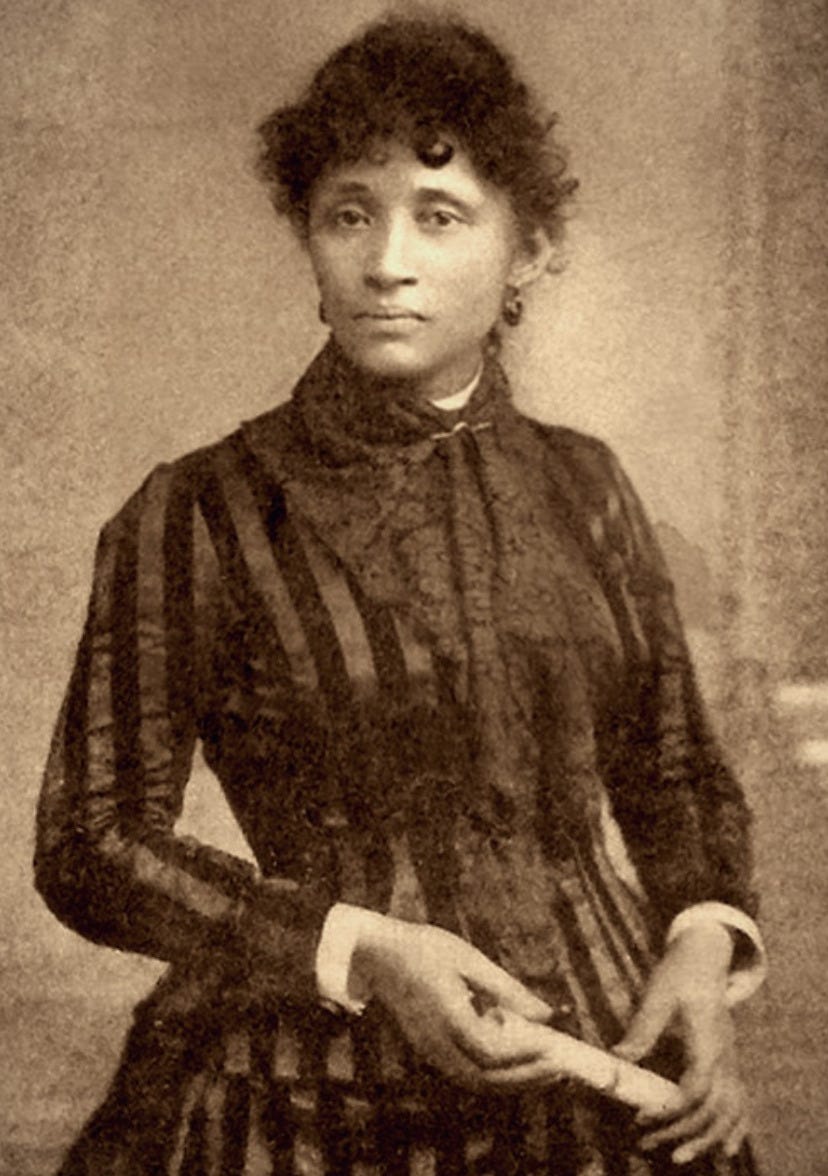
Chicago was rapidly becoming one of the main centers of industrial capitalism in the United States. Factories were expanding, immigrant labor poured into the city, and class tensions were intensifying. The city also became a center of radical politics where socialist and labor organizations grew quickly. Albert found work as a printer and became active in typographers’ unions and socialist organizations. Meanwhile, Lucy began working as a dressmaker while raising their children, Albert Parsons Jr. and Lulu Eda Parsons. Alongside her labor, she started speaking publicly and organizing workers, quickly revealing a natural talent for oratory and a fearless ability to rally people around the struggle for justice.
In 1877 Lucy and Albert both joined the Socialist Labor Party of America. That same year massive railroad strikes swept through the country and demonstrated how explosive the class struggle had become. Workers across various industries began questioning whether the economic system could ever serve their interests. In this political environment, Lucy Parsons increasingly advocated organizing workers directly rather than waiting for change through elections. She spoke to working people in language that was clear, forceful, and uncompromising, accurately identifying the contradictions they faced: wealth and political power were concentrated in the hands of a small elite, who would never relinquish their privileges voluntarily.
By the early 1880s, Lucy Parsons and her husband were deeply involved in the revolutionary wing of the labor movement. Albert helped establish the International Working People’s Association (IWPA) in 1883 and edited its radical newspaper, The Alarm, while Lucy was one of its main contributors, theorizing that violence was inevitable in class struggle and that trade unions were the engine of the revolution. She wrote texts including Our Civilization. Is It Worth Saving?, The Factory Child. Their Wrongs Portrayed and Their Rescue Demanded, and The Negro. Let Him Leave Politics to the Politician and Prayers to the Preacher.
Her article To Tramps, the Unemployed, the Disinherited and Miserable was reprinted from The Alarm and sold more than 10,000 copies in just six months. That same year, she published Dynamite! The Only Voice the Oppressors of the People Can Understand in the Denver Labor Enquirer, explicitly embracing Johann Most’s advocacy of propaganda of the deed, or the belief that the use of targeted acts of violence and criminality can advance revolutionary aims.
Parsons was also a prominent organizer in her own right. On April 28, 1885, she and Lizzie Holmes led an IWPA march to protest outside a banquet at the Board of Trade Building, newly constructed at a cost of $2 million. During this period, she and her partner regularly addressed crowds of 1,000 to 5,000 people on Sundays along the shore of Lake Michigan. Labor organizer Mother Jones attended these gatherings and noted that Parsons’ speeches advocated too much violence, highlighting a clear difference in approach between revolutionary and reformist currents within the labor movement.
In 1884, she helped lead the Poor People’s March in Chicago, protesting hunger, unemployment, and homelessness. The march highlighted the desperate conditions facing working-class neighborhoods and cemented Lucy Parsons’ reputation as a major organizer in her own right.
The major turning point, however, came during the struggle for the eight hour workday.
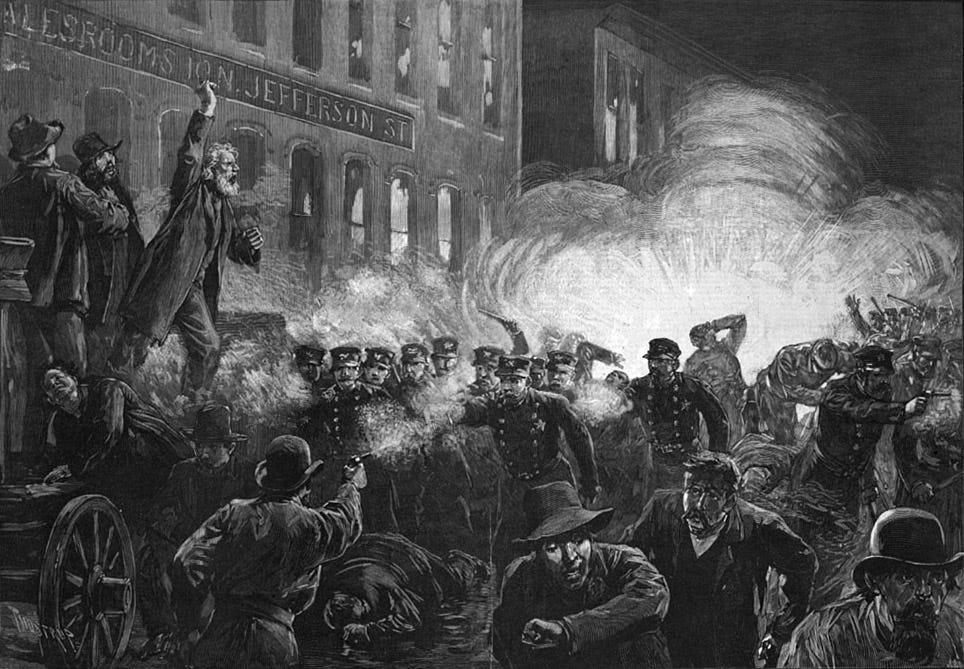
On May 1, 1886 workers across the whole of the United States launched mass demonstrations demanding shorter working hours. In Chicago the movement was enormous. Lucy and Albert participated in organizing a march of more than 80,000 workers through the city. Three days later a rally took place at Haymarket Square to protest police violence against striking workers. As police attempted to disperse the gathering an unknown individual threw a bomb. The explosion and gunfire that followed left several police officers and civilians dead. Authorities responded with sweeping repression against the labor movement.Eight anarchist activists, including Albert Parsons, were arrested and charged with conspiracy, marking one of the most infamous crackdowns on labor radicals in U.S. history.
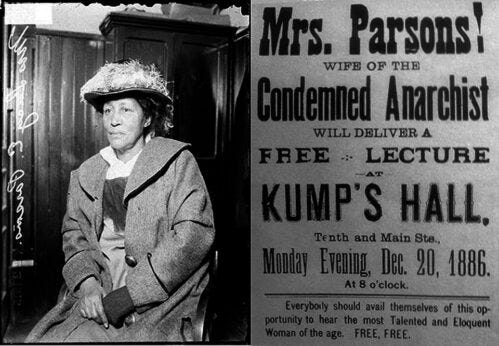
Although Albert Parsons had left the rally before the bombing and played no role in it, he was arrested and tried alongside the other defendants. The trial emphasized their political beliefs rather than concrete evidence of the crime. Parsons voluntarily surrendered to stand trial with his comrades, demonstrating solidarity with the labor movement. On November 11, 1887, Parsons and three other men were executed by hanging, a decision that became a symbol of injustice against labor activists.
Before the execution Lucy took their children to the prison hoping to see Albert one last time. Their son was seven years old and their daughter was five. Prison authorities refused to allow the meeting. Guards denied Lucy and the children the opportunity to say goodbye. The state hoped repression would silence the movement. She traveled across the country, giving fiery speeches that exposed the trial’s injustice and rallied workers to the cause. Crowds packed her lectures, and she quickly became one of the movement’s most formidable voices. Police saw her as a serious threat, with the Chicago Police Department reportedly describing her as more dangerous than a thousand rioters because she could inspire mass working-class resistance.
During this period, Lucy’s relationships with other prominent anarchists were also contentious. She met Emma Goldman through the Social Democracy of America in 1897, but their approaches clashed sharply. While Goldman celebrated free love, personal emancipation, and individual freedom, Lucy publicly defended monogamy, marriage, and motherhood, prioritizing the collective struggle of the working class above personal liberty. Their disagreement became personal and lasting when Lucy criticized Oscar Rotter’s advocacy of free love in the anarchist paper Free Society, provoking Goldman, who dismissed Lucy as exploiting her executed partner’s memory. Lucy, in contrast, focused relentlessly on organizing workers and building practical movements, exposing Goldman’s flair-driven activism as superficial compared with Lucy’s enduring commitment to labor struggle.
Lucy Parsons continued organizing through the decades that followed. By 1900 she was the Chicago correspondent for Free Society, a radical newspaper whose press had been destroyed by the police after the assassination of President McKinley. That same year she hosted the visiting Italian anarchist Errico Malatesta and spoke alongside trade unionist Jay Fox at a Memorial Day picnic, showing her ability to bring together laborers, radicals, and intellectuals. In 1905 she helped found the Industrial Workers of the World (IWW) alongside Eugene V. Debs, Bill Haywood, and Mother Jones, an organization that aimed to unite workers across trades, races, and nationalities into a single industrial movement capable of confronting the power of capital.
Over the next decades Lucy toured the country tirelessly, giving speeches, selling pamphlets, and editing radical newspapers like The Liberator and The Alarm. Police often tried to block her, particularly in Chicago, but she persisted in educating, mobilizing, and inspiring workers. In 1912 she hosted a meeting that established the Syndicalist League of North America under William Z. Foster, further cementing her role as a mentor and organizer of younger radicals.
Her work extended far beyond conventional union struggles, reaching unemployed workers, poor families, and society’s most marginalized. On January 17, 1915, Lucy led a march in Chicago protesting hunger and unemployment, organized by the IWW. It was during this event that the labor anthem Solidarity Forever was completed by IWW member Ralph Chaplin. Around 1,500 people, including children, took part in the demonstration. Police attacked the crowd with clubs and firearms, forcing the marchers to defend themselves. Witnesses reported that “women were fighting just as much as the men.” Twenty-one protesters, including Lucy, were arrested for their participation.
The Russian Revolution in 1917 profoundly reshaped Lucy’s political outlook, convincing her that communism was the only force capable of challenging the entrenched system of exploitation in the United States. She declared that communists were “the only bunch who are making a vigorous protest against the present horrible conditions” and dismissed anarchism as a “dead issue” in American life. Undeterred by critics, including Emma Goldman who accused her of jumping from one revolutionary cause to the next, Lucy threw herself into organizing through the International Labor Defense and speaking to massive crowds. Her fiery addresses, including a May Day 1930 speech to thousands at Chicago’s Ashland Auditorium, were later reprinted in government hearings investigating radical activity, cementing her reputation as one of the most formidable voices of U.S. working-class resistance.
Around 1910 Lucy began living with fellow activist George Markstall, who remained her companion for the rest of her life. Even into her eighties, she continued to challenge miscarriages of justice, speaking out for Angelo Herndon, Tom Mooney, and the Scottsboro Boys. Despite going blind and living in poverty, she maintained a library of roughly 3,000 books, including works by Marx, Engels, Victor Hugo, Jack London, Rousseau, Tolstoy, and Voltaire, reflecting the depth and breadth of her intellectual engagement.
Lucy’s decades of relentless struggle culminated in her formal joining of the Communist Party USA in 1939, uniting her lifelong activism for labor, racial, and gender justice with a clear Marxist vision. She carried this revolutionary commitment to the end of her life, leaving a legacy as one of the most important organizers in American labor history.
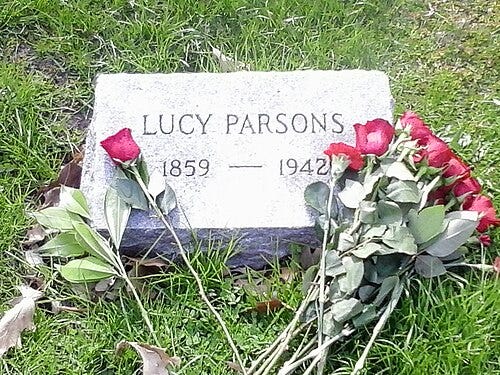
Lucy Parsons died on March 7, 1942, when a fire destroyed her Chicago home. George Markstall survived only briefly afterward. Even after her death the authorities demonstrated how seriously they had taken her influence, confiscating her papers, books, and personal writings. She was buried at Forest Home Cemetery near the monument to the Haymarket martyrs, and the ashes of Markstall and her son Albert Parsons Jr. were later placed in the same grave.
Her life reflected the long tradition of working-class resistance in the United States. She organized under intense repression, across lines of race and nationality, and in a political system that offered little hope for meaningful change. Through courage, persistence, and unyielding commitment to the oppressed, Lucy Parsons became one of the most important revolutionary organizers in American labor history.
Happy Women's History Month, comrades.